About
SSTDV
SSTDV is a research project for generating and evaluating synthetic training data from real-world spatiotemporal data, supported by IITP grant funded by the Korea government (MSIT).
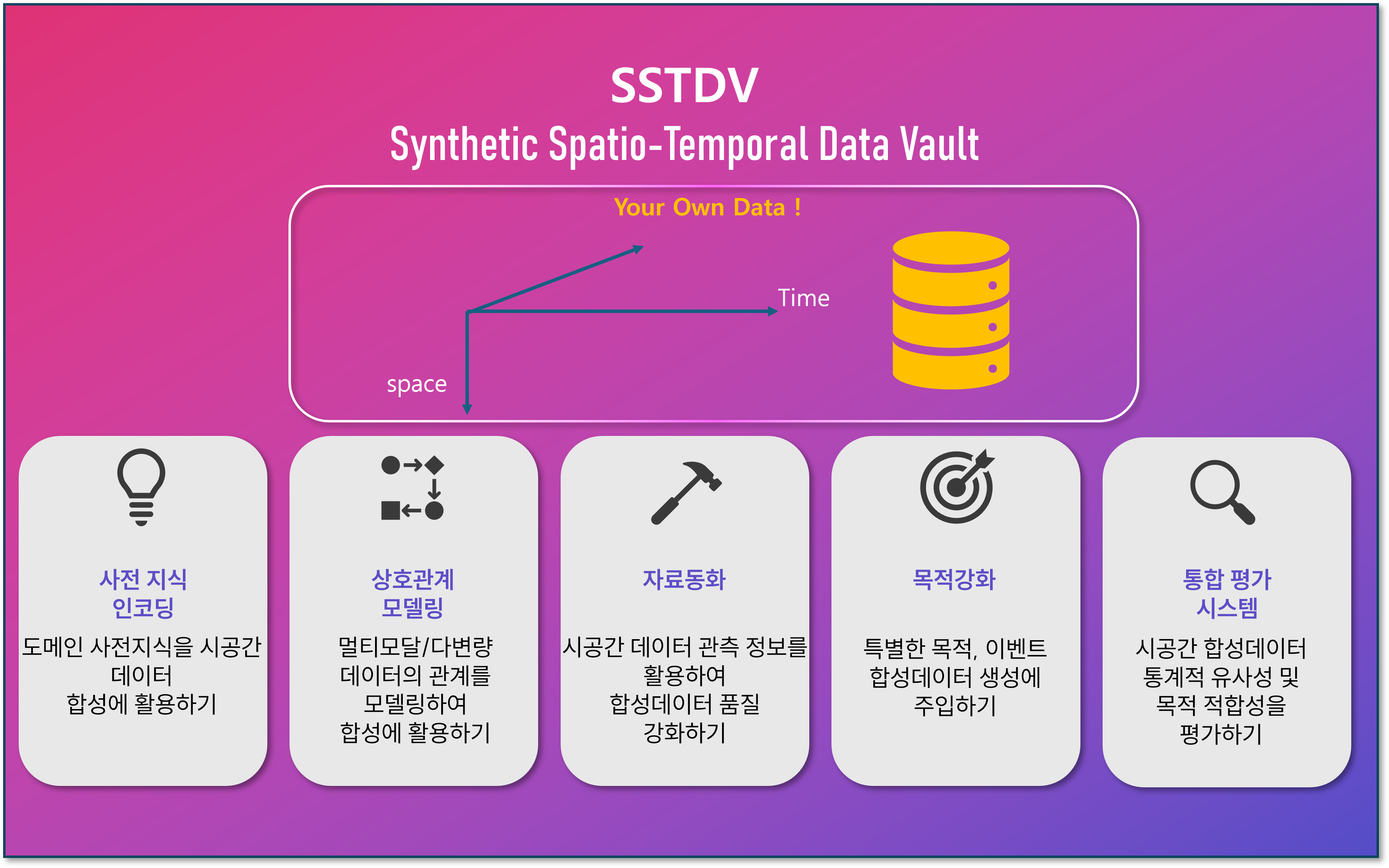
Research Areas
Core technical research areas spanning synthetic data generation, evaluation, and medical imaging applications.
Synthetic Data Generation
Developing methods to generate high-quality synthetic spatio-temporal data that preserves statistical properties of real-world data.
Knowledge Encoding
Explicitly encoding domain prior knowledge — structure, dynamics, and constraints — into generative models.
Relation Modeling
Modeling correlations, causality, and teleconnections among multivariate spatio-temporal data.
Data Assimilation
Correcting accumulated errors and missing data during generation through data perturbation techniques.
Objective-Reinforced Generation
Learning generation models using reward functions aligned with domain data requirements and objectives.
Evaluation of Synthetic Data
Quantitatively verifying synthetic data quality through statistical similarity and objective relevance metrics.
Medical Imaging Applications
Validating synthetic data effectiveness in brain imaging and breast cancer surgical simulation domains.
Participating Institutions
Five research institutions collaborating across generation, evaluation, and use case domains.
KAIST CGV
Brain MRI-based shape extraction and conditional image generation.
KIOST
Spatiotemporal dependency learning and sea surface temperature forecasting.
Dongguk University
Evaluation of multivariate distribution similarity and longitudinal brain MRI synthesis.
KAIST CNI
Evaluation of fitness-for-purpose using classification, detection, and prediction performance metrics.
Beamworks
Post-surgical breast MRI generation for medical twin-based surgical planning.
Research Goals
The SSTDV project pursues four core research objectives to advance synthetic spatio-temporal data technology.
- 1
High-quality synthetic data generation
Developing technology to generate high-quality synthetic data that reflects real-world spatio-temporal characteristics.
- 2
Domain knowledge-based generative models
Building generative models that explicitly encode domain knowledge including structure, dynamics, and physical constraints.
- 3
Purpose-oriented evaluation technology
Developing evaluation methods that verify synthetic data quality in terms of both statistical fidelity and task-specific utility.
- 4
Medical imaging validation
Validating the effectiveness of synthetic data in real-world medical imaging use cases: brain imaging and breast cancer surgical simulation.
Resources
Research & Use Cases
Access project research, use cases, publications & patents, and docs.
Project Outcomes
Contact
Get In Touch
For research inquiries and collaboration opportunities.
For project-related bug reports, feature requests, and open-source contributions.