Use Cases
Applications
Validated in two medical imaging domains, demonstrating the effectiveness of objective-reinforced synthetic data.
01 — Brain Imaging
Virtual Brain
Dongguk University · ADNI
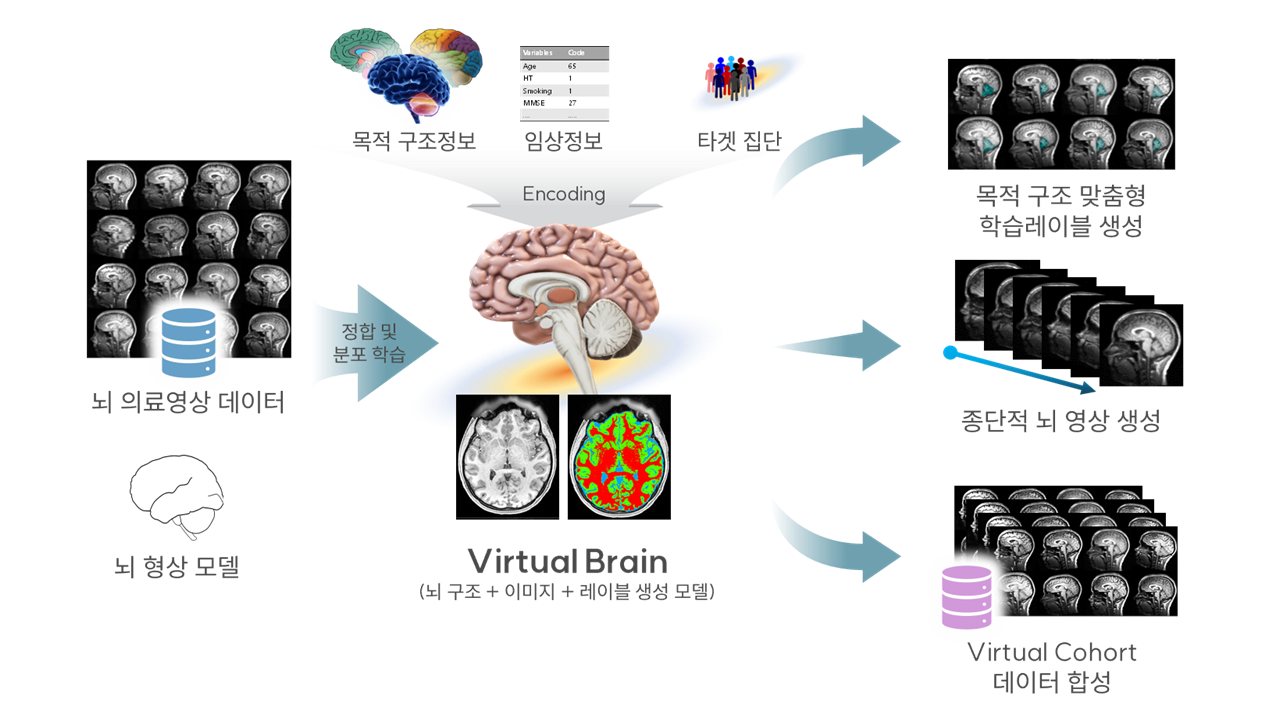
Virtual Brain is a framework that simulates longitudinal and chronic brain imaging changes associated with neurodegenerative diseases and generates synthetic brain imaging data that can be used for disease classification and prediction model development.
Data & Technologies
Brain imaging data from Dongguk University and the ADNI open dataset.
Evaluation
Distributional Similarity
Evaluating distributional similarity between real and synthetic brain images.
Reproducibility
Reproducibility of region-specific chronic brain changes.
Fitness-for-Purpose
Fitness-for-purpose for disease classification models.
02 — Breast Cancer
Breast Cancer Surgical Simulation
Beamworks · 1,483 pre/post-operative cases
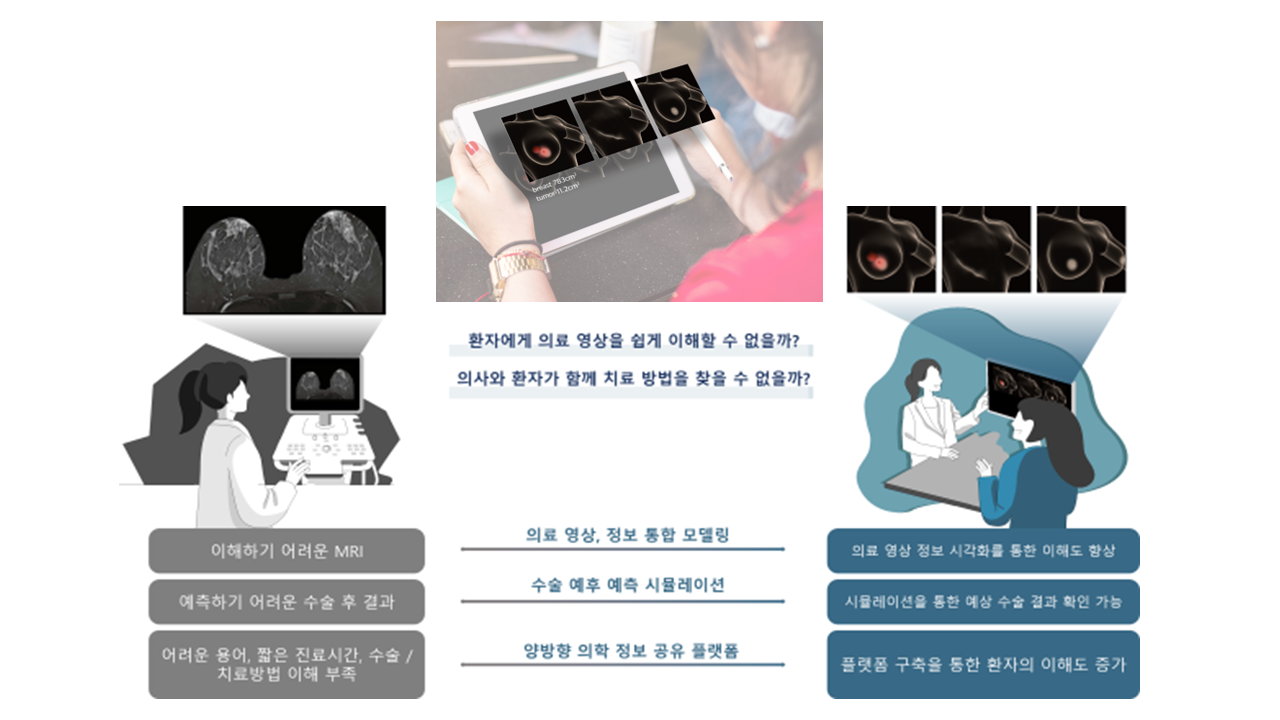
From a patient's pre-operative MRI and the planned surgery type, the model predicts the post-operative breast. The synthesized image displays the resection region and the resulting shape change. This lets physicians analyze the expected outcome before surgery and patients take part in the treatment decision.
Data & Technologies
The generative model is trained using 1,483 cases of pre-operative and post-operative breast MR images. The framework incorporates structural knowledge including resection regions, implant location, and implant size as conditioning information.
Pipeline
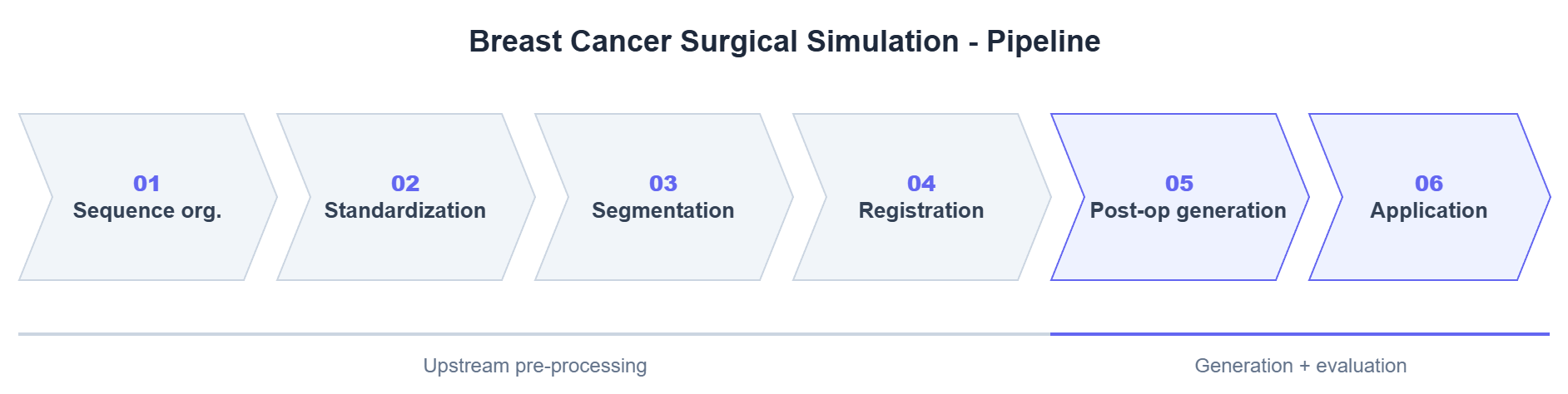
Sequence Organization
Raw DICOM files are automatically classified into clinically meaningful MRI series to support AI model input selection and user navigation.
Standardization
Breast MR images are standardized through orientation correction, N4-bias field removal, noise reduction, and normalization.
Segmentation
Breast tissue, tumor regions, resection regions, and implant-related structures are identified for quantitative analysis and generation conditioning.
Registration
Pre-operative and post-operative MR images are aligned to construct training data for longitudinal generative modeling.
Post-op generation
A generative model predicts post-surgical breast MRI from pre-operative MRI, conditioned on surgical plan, tumor location, resection region, and implant information.
Application
Generated results can be integrated into a medical twin-based surgical planning system with MRI visualization, segmentation, measurement, and 3D rendering modules.
Evaluation
Qualitative Evaluation
Turing tests in which breast cancer specialists compare synthetic and real post-surgical MR images.
Quantitative Evaluation
Agreement between generated and reference surgical regions (resection and implant) measured using Dice Similarity Coefficient (DSC).